Is solar still worth it in Amherst without the federal credit?
Paybacks lengthened when the 30% credit died - but hardware is the cheapest ever and Texas's export rules decide the real answer for Amherst roofs.
Installed home solar for Amherst homeowners averages about $2.58 a watt across the U.S. marketplace - roughly $30,960 for a 12 kW system before incentives.
Under Texas's export rules, compensation for surplus power decides the payback - which typically runs 10-14 years on unsubsidized 2026 math.
The 30% federal solar tax credit ended for installations finished after December 31, 2025 - Amherst systems completed in 2026 get $0 from it.
Beware of any 2026 payback estimate that looks as good as the 2025 ones: with the federal credit gone, a third of the old subsidy math vanished. If a sales projection has not gotten noticeably worse since 2025, it is hiding something - usually an inflated utility-rate escalation assumption.
Whether solar still pays in Texas after the federal credit's end comes down to arithmetic, not ideology: installed cost (about $2.58 a watt at the marketplace average), what your utility pays for exports, and how much of your generation you use yourself. High self-consumption - daytime usage, EV charging, batteries - is now the biggest lever.
The 2026 numbers
| System size | Installed price (marketplace avg) | Notes |
|---|---|---|
| 6 kW | $15,480 | Small roof / low usage |
| 8 kW | $20,640 | Typical starter system |
| 10 kW | $25,800 | Family home with AC |
| 12 kW | $30,960 | Large home / EV charging |
| Home battery (optional) | $12,000-$16,000 | Backup power + self-consumption |
Get solar quotes for Amherst
These platforms collect bids from licensed installers so you can compare against the same spec. Prices come from installers, not from this site.
Disclosure: this is an independent guide. If you request quotes through a link here, the platform may pay this site a referral fee. That fee never changes your quotes.
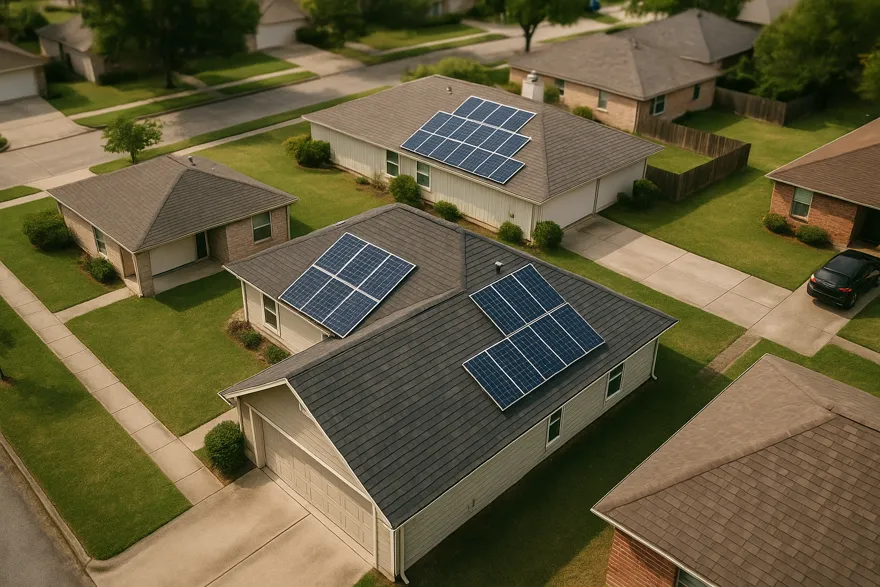
What this means for Amherst roofs
Beware of any 2026 payback estimate that looks as good as the 2025 ones: with the federal credit gone, a third of the old subsidy math vanished. If a sales projection has not gotten noticeably worse since 2025, it is hiding something - usually an inflated utility-rate escalation assumption.
This guide is research, not advice: an independent summary of published prices and state rules. It is not an installer, lender or tax advisor - verify incentive eligibility with a licensed tax professional before relying on it.
Getting Amherst quotes
Marketplace platforms collect bids from multiple TX installers against the same spec, which is the only clean way to compare - same roof, same size, different prices. Getting quotes is free and does not commit you to anything; prices come from the installers, never from this site.
This guide is research, not advice: an independent summary of published prices and state rules. It is not an installer, lender or tax advisor - verify incentive eligibility with a licensed tax professional before relying on it.
Common questions
Should I lease, get a PPA, or buy?
Buying keeps all savings and any incentives with you. Leases and PPAs put a company's equipment on your roof for 20-25 years, complicate a home sale, and in 2026 any tax benefits they advertise belong to the company under commercial rules - not to you. Read escalator clauses carefully.
Is there still a federal solar tax credit in 2026?
No. The 30% Residential Clean Energy Credit was repealed effective for systems placed in service after December 31, 2025, per the IRS. Only systems finished by the end of 2025 qualified. State-level incentives are separate and some survive - check the state page in this guide.
How long do solar panels actually last?
Panels are typically warrantied for 25 years of production and commonly outlive it, losing about 0.5% output per year. Inverters are the component that usually needs replacement - typically once, around year 12-15, at a few thousand dollars.
Is solar still worth it without the federal credit?
It depends mostly on your state's export rules and your daytime usage. Paybacks lengthened by roughly a third when the credit ended, but rising electricity rates and record-cheap hardware keep the math workable in states with decent export compensation - and marginal where exports pay avoided cost only.
How do I check if a solar quote is fair?
Divide the total price by the system's wattage. The U.S. marketplace average is about $2.58 per watt installed; $2.30-3.00 covers most fair quotes depending on roof complexity. Above that, ask exactly what you are paying extra for - in writing.
Get solar quotes for Amherst
These platforms collect bids from licensed installers so you can compare against the same spec. Prices come from installers, not from this site.
Disclosure: this is an independent guide. If you request quotes through a link here, the platform may pay this site a referral fee. That fee never changes your quotes.