What New York pays for your exported solar power
Export compensation is the single biggest payback lever in 2026. Here is New York's current rule in plain words, with the official source.
Under New York's export rules, compensation for surplus power decides the payback - which typically runs 10-14 years on unsubsidized 2026 math.
Installed home solar for Asharoken homeowners averages about $2.58 a watt across the U.S. marketplace - roughly $30,960 for a 12 kW system before incentives.
Asharoken, New York has about 608 residents, and its solar quotes are built from system size, roof complexity and export rules - not the town name.
Beware of any 2026 payback estimate that looks as good as the 2025 ones: with the federal credit gone, a third of the old subsidy math vanished. If a sales projection has not gotten noticeably worse since 2025, it is hiding something - usually an inflated utility-rate escalation assumption.
Whether solar still pays in New York after the federal credit's end comes down to arithmetic, not ideology: installed cost (about $2.58 a watt at the marketplace average), what your utility pays for exports, and how much of your generation you use yourself. High self-consumption - daytime usage, EV charging, batteries - is now the biggest lever.
The 2026 numbers
| System size | Installed price (marketplace avg) | Notes |
|---|---|---|
| 6 kW | $15,480 | Small roof / low usage |
| 8 kW | $20,640 | Typical starter system |
| 10 kW | $25,800 | Family home with AC |
| 12 kW | $30,960 | Large home / EV charging |
| Home battery (optional) | $12,000-$16,000 | Backup power + self-consumption |
Get solar quotes for Asharoken
These platforms collect bids from licensed installers so you can compare against the same spec. Prices come from installers, not from this site.
Disclosure: this is an independent guide. If you request quotes through a link here, the platform may pay this site a referral fee. That fee never changes your quotes.
New York rules that decide your payback
| Rule | New York status |
|---|---|
| Export compensation (net metering) | Traditional (Phase One) net metering is still available for residential rooftop solar up to 25 kW - the customer is billed only for net electricity consumed and surplus kWh roll forward as credits - but any system interconnected on or after January 1, 2022 also pays a monthly Customer Benefit Contribution (CBC) charge based on DC nameplate size (2026 residential rates $0.97-$1.67 per kW-month depending on utility), while larger and front-of-meter projects are compensated under the VDER Value Stack instead. |
| State incentive | NY State Solar Energy System Equipment Credit (25% of qualified expenditures, capped at $5,000, non-refundable with 5-year carryover) plus the NY-Sun MW Block incentive administered by NYSERDA (per-watt, varies by region and block; Upstate Residential Block 14 was the active residential block as of 2026) |
| Sales tax on the system | Exempt |
| Property tax on added home value | Excluded |
The RPTL 487 property tax exemption runs only 15 years and each county, city, town, village and school district may individually opt out of it, so the exemption is not guaranteed everywhere; New York City separately runs its own solar property tax abatement program.
This guide is research, not advice: an independent summary of published prices and state rules. It is not an installer, lender or tax advisor - verify incentive eligibility with a licensed tax professional before relying on it.
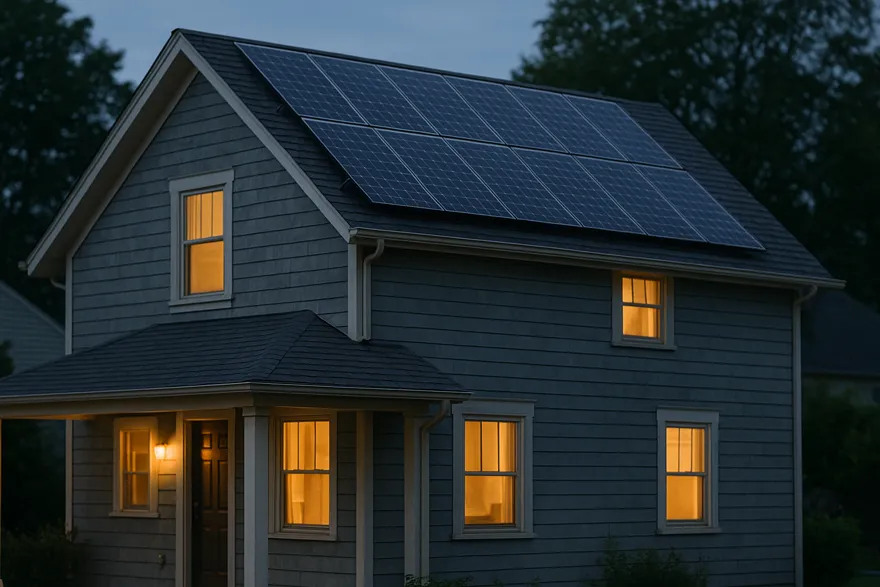
What this means for Asharoken roofs
Beware of any 2026 payback estimate that looks as good as the 2025 ones: with the federal credit gone, a third of the old subsidy math vanished. If a sales projection has not gotten noticeably worse since 2025, it is hiding something - usually an inflated utility-rate escalation assumption.
This guide is research, not advice: an independent summary of published prices and state rules. It is not an installer, lender or tax advisor - verify incentive eligibility with a licensed tax professional before relying on it.
Getting Asharoken quotes
The spread between the highest and lowest bid for the same roof routinely hits 30-50%, because solar quotes carry very different sales overheads. Two or three independent bids collected against the same system size is the single highest-value hour in the whole project.
This guide is research, not advice: an independent summary of published prices and state rules. It is not an installer, lender or tax advisor - verify incentive eligibility with a licensed tax professional before relying on it.
Common questions
What happens if my installer goes out of business?
Panel and inverter warranties come from the manufacturers and survive, but the workmanship warranty usually dies with the company. That is a real risk in the post-credit shakeout - prefer installers with years of local history, and get manufacturer-backed workmanship coverage where offered.
Should I lease, get a PPA, or buy?
Buying keeps all savings and any incentives with you. Leases and PPAs put a company's equipment on your roof for 20-25 years, complicate a home sale, and in 2026 any tax benefits they advertise belong to the company under commercial rules - not to you. Read escalator clauses carefully.
How do I check if a solar quote is fair?
Divide the total price by the system's wattage. The U.S. marketplace average is about $2.58 per watt installed; $2.30-3.00 covers most fair quotes depending on roof complexity. Above that, ask exactly what you are paying extra for - in writing.
What is net metering and why does it decide everything?
It is the rule for how your utility credits electricity you export. Full retail net metering credits exports at the same rate you pay - the grid works like a free battery. Net billing or avoided-cost rules pay far less per exported kWh, which lengthens payback and strengthens the case for a home battery.
Is my roof even suitable for solar?
Three things decide it: orientation (south-facing is best in the U.S., east-west workable), shade (trees or taller buildings across midday hours can sink the math), and roof age (if the shingles have under 10 years left, reroof first - removing and reinstalling panels later costs thousands). Any honest installer assesses all three before quoting a number.
Get solar quotes for Asharoken
These platforms collect bids from licensed installers so you can compare against the same spec. Prices come from installers, not from this site.
Disclosure: this is an independent guide. If you request quotes through a link here, the platform may pay this site a referral fee. That fee never changes your quotes.
Prices in nearby cities
Athens · Atlantic Beach · Attica · Auburn · Aurora · Avoca · Avon · Babylon · Bainbridge · Baldwinsville · Ballston Spa · Barker