What Montana still offers after the federal credit ended
Every incentive on this page is verified against Montana government sources - and the expired ones salespeople still quote are called out.
The 30% federal solar tax credit ended for installations finished after December 31, 2025 - Bozeman systems completed in 2026 get $0 from it.
Under Montana's export rules, compensation for surplus power decides the payback - which typically runs 10-14 years on unsubsidized 2026 math.
Installed home solar for Bozeman homeowners averages about $2.58 a watt across the U.S. marketplace - roughly $30,960 for a 12 kW system before incentives.
The federal Residential Clean Energy Credit - the 30% one every solar ad still quotes - was repealed by the One Big Beautiful Bill Act signed July 4, 2025. Per the IRS, it is not available for any system placed in service after December 31, 2025, and 'placed in service' means the installation completion date, not the contract date.
If a salesperson in Bozeman tells you a 30% federal tax credit applies to your 2026 installation, they are quoting a dead law. What may still exist: Montana's own incentives and tax treatment, listed below, and lease/PPA arrangements where a company claims commercial credits - in which case the credit belongs to them, not you.
The 2026 numbers
| System size | Installed price (marketplace avg) | Notes |
|---|---|---|
| 6 kW | $15,480 | Small roof / low usage |
| 8 kW | $20,640 | Typical starter system |
| 10 kW | $25,800 | Family home with AC |
| 12 kW | $30,960 | Large home / EV charging |
| Home battery (optional) | $12,000-$16,000 | Backup power + self-consumption |
Get solar quotes for Bozeman
These platforms collect bids from licensed installers so you can compare against the same spec. Prices come from installers, not from this site.
Disclosure: this is an independent guide. If you request quotes through a link here, the platform may pay this site a referral fee. That fee never changes your quotes.
Montana rules that decide your payback
| Rule | Montana status |
|---|---|
| Export compensation (net metering) | Montana statute requires utilities to offer net metering to customer-generators whose solar, wind or hydropower facility has a generating capacity of not more than 50 kilowatts (MCA 69-8-103), measuring net electricity each billing period and crediting excess kilowatt-hours on the following month's bill (MCA 69-8-603). |
| State incentive | Nonfossil Energy Generation property tax exemption (MCA 15-6-224) - up to $20,000 of capital investment value on a single-family residential dwelling, exempt for 10 years following installation; Montana's former residential alternative energy income tax credit (MCA 15-32-201) was repealed in 2021. |
| Sales tax on the system | Exempt |
| Property tax on added home value | Excluded |
Montana wipes the slate clean once a year: on January 1, April 1, July 1 or October 1, any remaining unused kilowatt-hour credit accumulated during the previous 12 months 'must be granted to the electricity supplier, without any compensation to the customer-generator' - unlike Wyoming, which at least pays avoided cost, Montana pays nothing, so an oversized system donates its surplus to the utility.
This guide is research, not advice: an independent summary of published prices and state rules. It is not an installer, lender or tax advisor - verify incentive eligibility with a licensed tax professional before relying on it.
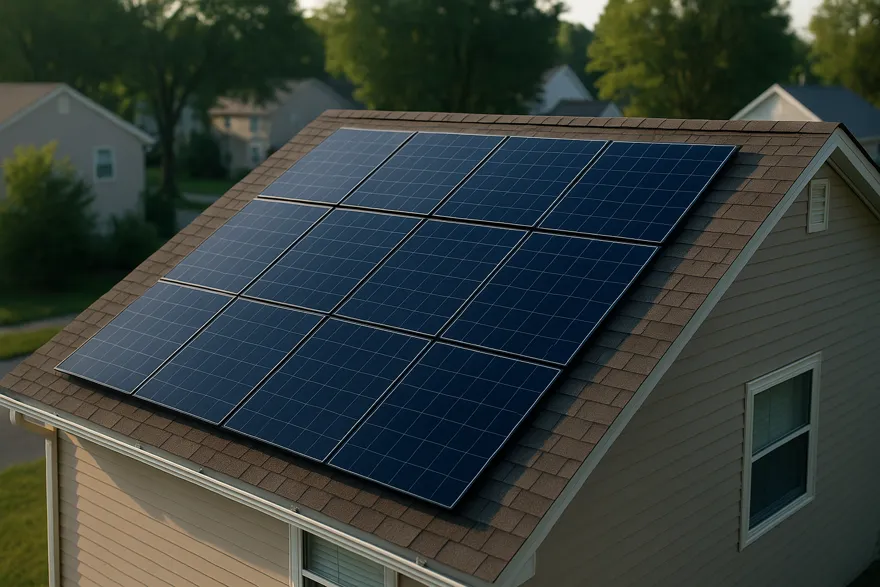
What this means for Bozeman roofs
Beware of any 2026 payback estimate that looks as good as the 2025 ones: with the federal credit gone, a third of the old subsidy math vanished. If a sales projection has not gotten noticeably worse since 2025, it is hiding something - usually an inflated utility-rate escalation assumption.
This guide is research, not advice: an independent summary of published prices and state rules. It is not an installer, lender or tax advisor - verify incentive eligibility with a licensed tax professional before relying on it.
Getting Bozeman quotes
Before requesting quotes, have your last 12 months of electricity bills handy - system sizing should follow your real usage, not a salesperson's template. A bid sized far above your usage is a margin play, especially now that surplus export pays less in most states.
This guide is research, not advice: an independent summary of published prices and state rules. It is not an installer, lender or tax advisor - verify incentive eligibility with a licensed tax professional before relying on it.
Common questions
Do I need a battery with my solar?
Not necessarily. Under full retail net metering, the grid effectively stores your surplus for free. Batteries earn their $12,000-16,000 price where export rates are low, outages are common, or time-of-use rates make evening self-consumption valuable.
What is net metering and why does it decide everything?
It is the rule for how your utility credits electricity you export. Full retail net metering credits exports at the same rate you pay - the grid works like a free battery. Net billing or avoided-cost rules pay far less per exported kWh, which lengthens payback and strengthens the case for a home battery.
How do I check if a solar quote is fair?
Divide the total price by the system's wattage. The U.S. marketplace average is about $2.58 per watt installed; $2.30-3.00 covers most fair quotes depending on roof complexity. Above that, ask exactly what you are paying extra for - in writing.
Does solar raise my property taxes?
It depends on the state - many exempt solar's added home value from property tax, others do not, and some exemptions have expiration dates. This guide's state page lists the verified rule and source for your state.
Should I lease, get a PPA, or buy?
Buying keeps all savings and any incentives with you. Leases and PPAs put a company's equipment on your roof for 20-25 years, complicate a home sale, and in 2026 any tax benefits they advertise belong to the company under commercial rules - not to you. Read escalator clauses carefully.
Get solar quotes for Bozeman
These platforms collect bids from licensed installers so you can compare against the same spec. Prices come from installers, not from this site.
Disclosure: this is an independent guide. If you request quotes through a link here, the platform may pay this site a referral fee. That fee never changes your quotes.