What Pennsylvania pays for your exported solar power
Export compensation is the single biggest payback lever in 2026. Here is Pennsylvania's current rule in plain words, with the official source.
Under Pennsylvania's export rules, compensation for surplus power decides the payback - which typically runs 10-14 years on unsubsidized 2026 math.
Installed home solar for Catasauqua homeowners averages about $2.58 a watt across the U.S. marketplace - roughly $30,960 for a 12 kW system before incentives.
Catasauqua, Pennsylvania has about 6,625 residents, and its solar quotes are built from system size, roof complexity and export rules - not the town name.
Whether solar still pays in Pennsylvania after the federal credit's end comes down to arithmetic, not ideology: installed cost (about $2.58 a watt at the marketplace average), what your utility pays for exports, and how much of your generation you use yourself. High self-consumption - daytime usage, EV charging, batteries - is now the biggest lever.
The honest 2026 answer for Catasauqua: solar pays back slower without the 30% credit - paybacks that ran 7-10 years often now run 10-14 - but electricity rates keep rising and hardware is the cheapest it has ever been. The deciding factor is Pennsylvania's export compensation, covered in the net metering section.
The 2026 numbers
| System size | Installed price (marketplace avg) | Notes |
|---|---|---|
| 6 kW | $15,480 | Small roof / low usage |
| 8 kW | $20,640 | Typical starter system |
| 10 kW | $25,800 | Family home with AC |
| 12 kW | $30,960 | Large home / EV charging |
| Home battery (optional) | $12,000-$16,000 | Backup power + self-consumption |
Get solar quotes for Catasauqua
These platforms collect bids from licensed installers so you can compare against the same spec. Prices come from installers, not from this site.
Disclosure: this is an independent guide. If you request quotes through a link here, the platform may pay this site a referral fee. That fee never changes your quotes.
Pennsylvania rules that decide your payback
| Rule | Pennsylvania status |
|---|---|
| Export compensation (net metering) | Full retail net metering: electric distribution companies must credit customer-generators "at the full retail kilowatt-hour rate, which shall include generation, transmission and distribution charges," for residential systems up to 50 kW, with excess kWh accumulating until year-end when the default service provider cashes them out at its price-to-compare rate (52 Pa. Code § 75.13). |
| State incentive | Pennsylvania SREC market under the Alternative Energy Portfolio Standards Act (Act 213 of 2004) — a net-metered customer-generator owns the alternative energy credits its system produces and may sell SRECs; Act 40 of 2017 restricted eligibility to systems delivering power inside Pennsylvania. There is no statewide solar rebate or state tax credit, and PA Solar for All is not operational. |
| Sales tax on the system | Not exempt - taxed like any purchase |
| Property tax on added home value | No exclusion on record |
Pennsylvania's $156 million federally funded Solar for All program has never launched — DEP's own page states "The Pennsylvania Solar for All program is not operational at this time" and warns homeowners to disregard any solar installer claiming to be an active Solar for All partner. Treat any such sales pitch as a red flag.
This guide is research, not advice: an independent summary of published prices and state rules. It is not an installer, lender or tax advisor - verify incentive eligibility with a licensed tax professional before relying on it.
What this means for Catasauqua roofs
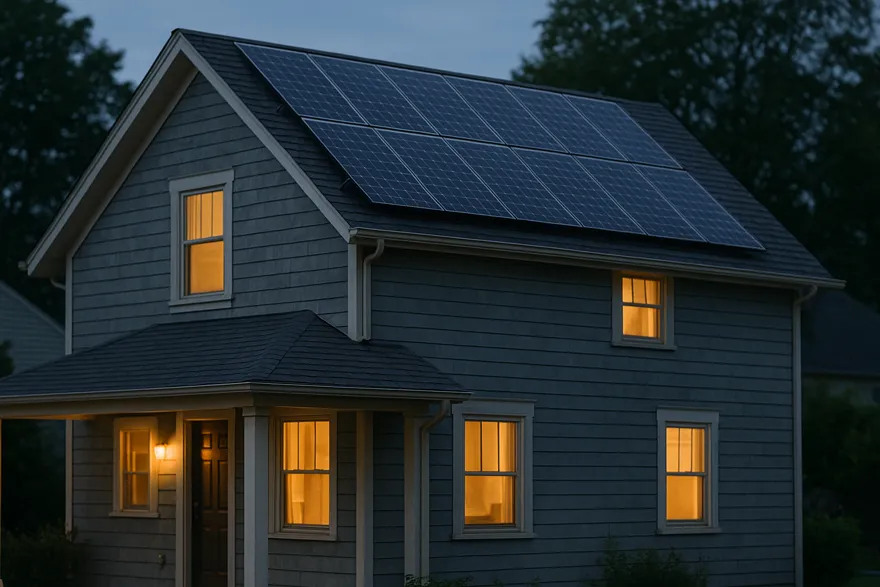
Whether solar still pays in Pennsylvania after the federal credit's end comes down to arithmetic, not ideology: installed cost (about $2.58 a watt at the marketplace average), what your utility pays for exports, and how much of your generation you use yourself. High self-consumption - daytime usage, EV charging, batteries - is now the biggest lever.
This guide is research, not advice: an independent summary of published prices and state rules. It is not an installer, lender or tax advisor - verify incentive eligibility with a licensed tax professional before relying on it.
Getting Catasauqua quotes
Marketplace platforms collect bids from multiple PA installers against the same spec, which is the only clean way to compare - same roof, same size, different prices. Getting quotes is free and does not commit you to anything; prices come from the installers, never from this site.
This guide is research, not advice: an independent summary of published prices and state rules. It is not an installer, lender or tax advisor - verify incentive eligibility with a licensed tax professional before relying on it.
Common questions
Is there still a federal solar tax credit in 2026?
No. The 30% Residential Clean Energy Credit was repealed effective for systems placed in service after December 31, 2025, per the IRS. Only systems finished by the end of 2025 qualified. State-level incentives are separate and some survive - check the state page in this guide.
Should I lease, get a PPA, or buy?
Buying keeps all savings and any incentives with you. Leases and PPAs put a company's equipment on your roof for 20-25 years, complicate a home sale, and in 2026 any tax benefits they advertise belong to the company under commercial rules - not to you. Read escalator clauses carefully.
Is my roof even suitable for solar?
Three things decide it: orientation (south-facing is best in the U.S., east-west workable), shade (trees or taller buildings across midday hours can sink the math), and roof age (if the shingles have under 10 years left, reroof first - removing and reinstalling panels later costs thousands). Any honest installer assesses all three before quoting a number.
How much does home solar cost in 2026?
The U.S. marketplace average is about $2.58 per watt installed - roughly $15,500 for a 6 kW system and $31,000 for 12 kW, before any state incentives. Quotes meaningfully above that level deserve a written explanation of what justifies the premium.
What is net metering and why does it decide everything?
It is the rule for how your utility credits electricity you export. Full retail net metering credits exports at the same rate you pay - the grid works like a free battery. Net billing or avoided-cost rules pay far less per exported kWh, which lengthens payback and strengthens the case for a home battery.
Get solar quotes for Catasauqua
These platforms collect bids from licensed installers so you can compare against the same spec. Prices come from installers, not from this site.
Disclosure: this is an independent guide. If you request quotes through a link here, the platform may pay this site a referral fee. That fee never changes your quotes.
Prices in nearby cities
Catawissa · Centerport · Centerville · Central City · Centralia · Centre Hall · Chalfant · Chalfont · Chambersburg · Chapman · Charleroi · Cherry Tree