What Maryland still offers after the federal credit ended
Every incentive on this page is verified against Maryland government sources - and the expired ones salespeople still quote are called out.
The 30% federal solar tax credit ended for installations finished after December 31, 2025 - Greenbelt systems completed in 2026 get $0 from it.
Under Maryland's export rules, compensation for surplus power decides the payback - which typically runs 10-14 years on unsubsidized 2026 math.
Installed home solar for Greenbelt homeowners averages about $2.58 a watt across the U.S. marketplace - roughly $30,960 for a 12 kW system before incentives.
Leased and PPA systems deserve extra scrutiny in 2026: the sales pitch often bundles 'tax savings' that now accrue to the leasing company under separate commercial rules - not to you. Get every claimed saving in writing, attributed to a specific law, before signing a 20-25 year contract.
The federal Residential Clean Energy Credit - the 30% one every solar ad still quotes - was repealed by the One Big Beautiful Bill Act signed July 4, 2025. Per the IRS, it is not available for any system placed in service after December 31, 2025, and 'placed in service' means the installation completion date, not the contract date.
The 2026 numbers
| System size | Installed price (marketplace avg) | Notes |
|---|---|---|
| 6 kW | $15,480 | Small roof / low usage |
| 8 kW | $20,640 | Typical starter system |
| 10 kW | $25,800 | Family home with AC |
| 12 kW | $30,960 | Large home / EV charging |
| Home battery (optional) | $12,000-$16,000 | Backup power + self-consumption |
Get solar quotes for Greenbelt
These platforms collect bids from licensed installers so you can compare against the same spec. Prices come from installers, not from this site.
Disclosure: this is an independent guide. If you request quotes through a link here, the platform may pay this site a referral fee. That fee never changes your quotes.
Maryland rules that decide your payback
| Rule | Maryland status |
|---|---|
| Export compensation (net metering) | Full retail net energy metering: systems up to 2 MW are eligible and the program stays open until statewide net-metered capacity reaches 3,000 MW; monthly excess means the customer "is billed only customer charges for that month," and accrued net excess generation is cashed out within 30 days after the billing cycle ending before the end of April each year at the generation/commodity portion of the rate averaged over the prior 12 months (Md. Code, Pub. Util. § 7-306). |
| State incentive | Maryland Solar Access Program (Maryland Energy Administration) — an income-eligible upfront rebate for residential solar PV; the FY27 round opened July 29, 2026 with applications due May 31, 2027 and up to $10 million available from the Strategic Energy Investment Fund. Maryland SRECs, earned under the state RPS solar carve-out, remain saleable by the homeowner. |
| Sales tax on the system | Exempt |
| Property tax on added home value | Excluded |
The old flat $1,000 Residential Clean Energy Rebate is no longer available for solar PV — MEA's current incentives page lists only the income-capped Maryland Solar Access Program for residential solar, so a household above the income limits (e.g. roughly $195,375 for a family of four in FY27) now gets no upfront state cash, only SRECs. Net metering also runs against a hard 3,000 MW statewide cap.
This guide is research, not advice: an independent summary of published prices and state rules. It is not an installer, lender or tax advisor - verify incentive eligibility with a licensed tax professional before relying on it.
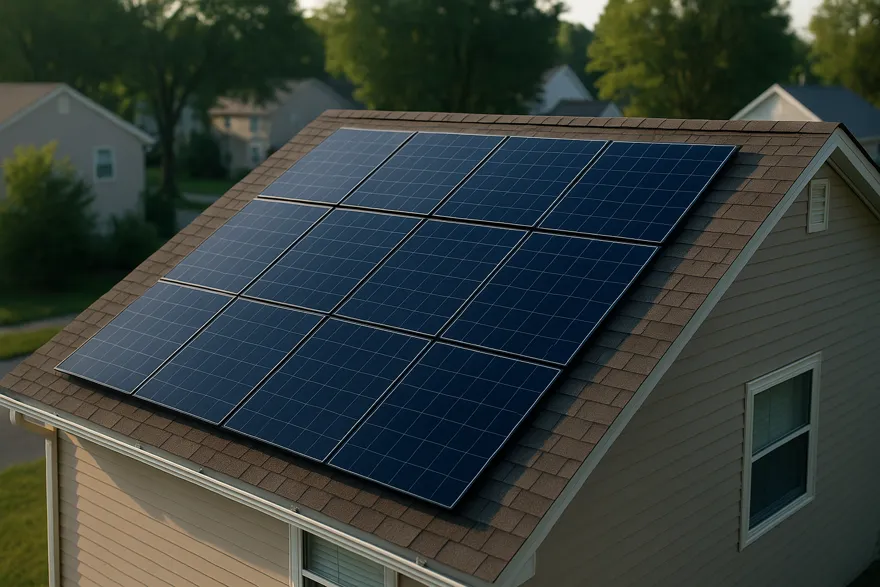
What this means for Greenbelt roofs
Whether solar still pays in Maryland after the federal credit's end comes down to arithmetic, not ideology: installed cost (about $2.58 a watt at the marketplace average), what your utility pays for exports, and how much of your generation you use yourself. High self-consumption - daytime usage, EV charging, batteries - is now the biggest lever.
This guide is research, not advice: an independent summary of published prices and state rules. It is not an installer, lender or tax advisor - verify incentive eligibility with a licensed tax professional before relying on it.
Getting Greenbelt quotes
Marketplace platforms collect bids from multiple MD installers against the same spec, which is the only clean way to compare - same roof, same size, different prices. Getting quotes is free and does not commit you to anything; prices come from the installers, never from this site.
This guide is research, not advice: an independent summary of published prices and state rules. It is not an installer, lender or tax advisor - verify incentive eligibility with a licensed tax professional before relying on it.
Common questions
Is solar still worth it without the federal credit?
It depends mostly on your state's export rules and your daytime usage. Paybacks lengthened by roughly a third when the credit ended, but rising electricity rates and record-cheap hardware keep the math workable in states with decent export compensation - and marginal where exports pay avoided cost only.
How long do solar panels actually last?
Panels are typically warrantied for 25 years of production and commonly outlive it, losing about 0.5% output per year. Inverters are the component that usually needs replacement - typically once, around year 12-15, at a few thousand dollars.
How much does home solar cost in 2026?
The U.S. marketplace average is about $2.58 per watt installed - roughly $15,500 for a 6 kW system and $31,000 for 12 kW, before any state incentives. Quotes meaningfully above that level deserve a written explanation of what justifies the premium.
Does solar raise my property taxes?
It depends on the state - many exempt solar's added home value from property tax, others do not, and some exemptions have expiration dates. This guide's state page lists the verified rule and source for your state.
Is there still a federal solar tax credit in 2026?
No. The 30% Residential Clean Energy Credit was repealed effective for systems placed in service after December 31, 2025, per the IRS. Only systems finished by the end of 2025 qualified. State-level incentives are separate and some survive - check the state page in this guide.
Get solar quotes for Greenbelt
These platforms collect bids from licensed installers so you can compare against the same spec. Prices come from installers, not from this site.
Disclosure: this is an independent guide. If you request quotes through a link here, the platform may pay this site a referral fee. That fee never changes your quotes.
Prices in nearby cities
Greensboro · Hagerstown · Hampstead · Hancock · Havre de Grace · Hebron · Henderson · Highland Beach · Hillsboro · Hurlock · Hyattsville · Indian Head